I am Sarah Jenkins. At thirty-four, I was a pediatric trauma nurse currently on an indefinite sabbatical. After a decade of pulling broken children back from the brink in the emergency room, the ghosts had simply become too loud to ignore. I moved to this upscale, quiet neighborhood looking for a sanctuary. Instead, I found a front-row seat to a beautifully manicured horror show.
My gaze, trained by years of clinical observation to spot hidden fractures, had long been fixated on the property line I shared with Brad and Tiffany Miller. They were the undisputed royalty of the cul-de-sac. Their lawn was a chemically perfected emerald green; their driveway boasted matching imported luxury SUVs. They were beautiful, wealthy, and deeply, fundamentally hollow. But it wasn’t their flawless public persona that unsettled me. It was the eerie, unnatural silence of their eight-year-old son, Leo.
I remembered the Fourth of July block party clearly. It was a vibrant sea of red, white, and blue, filled with the scent of barbecue and the sound of laughing children. I had watched from my porch as Leo stood frozen near the edge of the Millers’ driveway, completely isolated from the neighborhood kids playing tag. He was wearing a heavy, oversized flannel shirt despite the ninety-degree heat. He possessed a perpetually haunted gaze, displaying an unnatural, robotic obedience whenever his parents were within sight.
That day, I had approached him, offering a brightly frosted cupcake and a warm, disarming smile. Leo’s eyes had darted frantically toward his house. Before his small fingers could even brush the frosting, Tiffany Miller materialized like a phantom. Her grip on Leo’s narrow shoulder was bone-crushing, her manicured nails digging deep into the flannel fabric.
“Leo has a very strict diet, Sarah,” Tiffany had said, her voice dripping with venomous, manufactured sweetness, her smile never reaching her cold, dead eyes. “He knows what happens when he disobeys.”
She had yanked the boy backward so violently his neck snapped back, leaving me standing alone with a crushed cupcake and a rising sense of dread. The rest of the community willfully ignored these subtle red flags because the Millers were “such a respectable, high-class family.”
The memory faded as a sharp crack of thunder brought me back to the freezing November present. I peered out through the rain-streaked glass. Through the biting, hypothermic cold of the downpour, I noticed a small, shivering shadow huddled against my porch railing. It was Leo. He was soaked to the bone, clutching a cheap canvas backpack to his chest. My heart hammered against my ribs. I knew that if I opened that heavy wooden door to let the freezing rain in, I might never be able to close it again.
Chapter 2: The Backpack’s Secret
The biting, hypothermic cold of the Seattle downpour immediately whipped through my hallway as I pulled the door open. Leo stumbled inside, his lips a terrifying shade of blue, his small body vibrating with violent tremors.
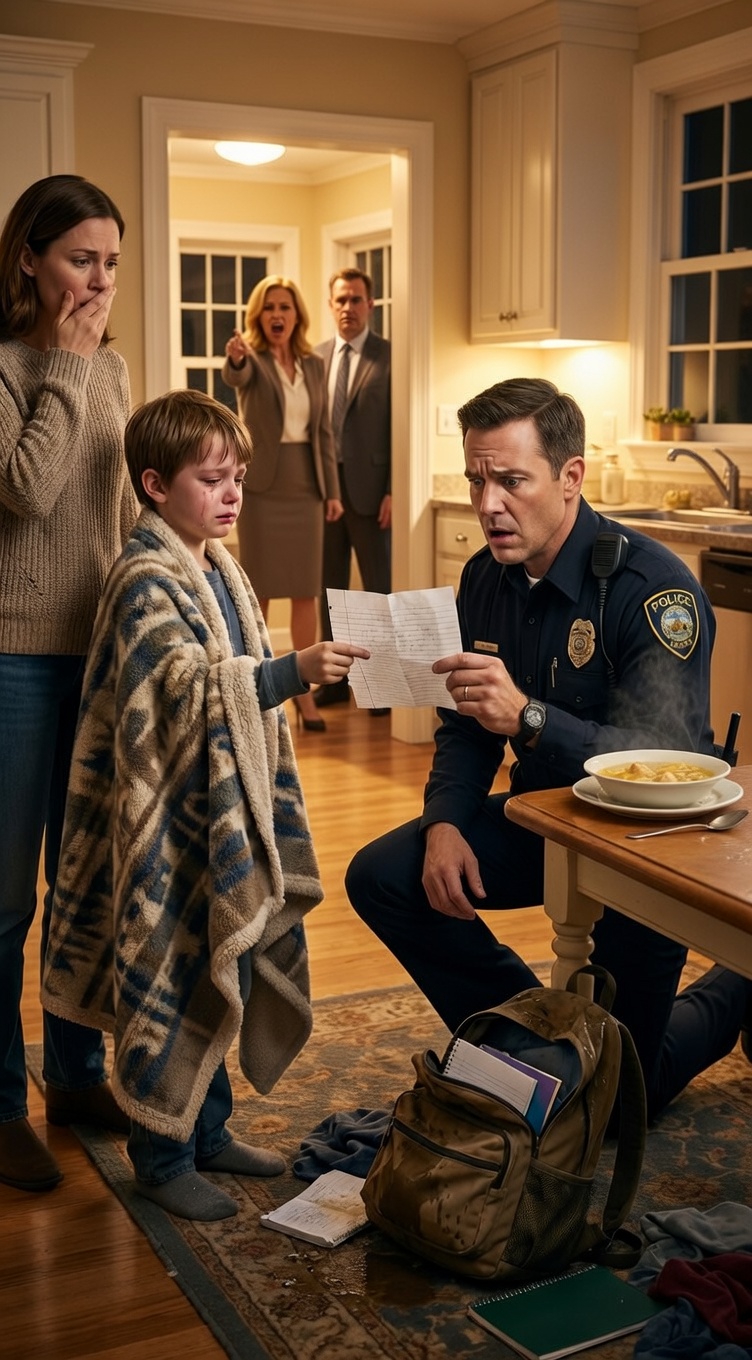
“Come here, sweetie, you’re freezing,” I urged, rushing him into the warmth of the kitchen. I stripped off his soaked outer jacket, wrapped his fragile frame in a heavy fleece blanket, and quickly microwaved a steaming bowl of chicken soup. He didn’t touch the spoon. He just stared at the surface of the broth, his chest heaving with shallow, panicked breaths.
Before I could even ask him what happened, the tranquility of my home was violently shattered.
The heavy oak front door slammed against the wall with a deafening CRACK.
Brad Miller stormed into the living room, water dripping from his designer coat, his face twisted into a mask of theatrical terror and rage. He pointed a trembling, accusatory finger directly at me. Flanking him was a frantic, weeping Tiffany and an imposing, heavy-set uniformed police officer.
“Arrest that bitch! She kidnapped my son!” Brad roared, playing the role of the terrified father with terrifying perfection. He weaponized his social standing instantly, his voice booming with absolute authority.
The police officer stepped forward, his jaw tight, his hand instinctively unbuttoning the leather pouch of his handcuffs. “Ma’am, turn around and place your hands behind your back,” the officer commanded, the metallic clink of the cuffs echoing in the tense room.
I opened my mouth to explain, but a sudden, desperate movement stopped me.
Leo scrambled backward off the kitchen chair, the fleece blanket falling to the floor. With a feral, desperate grunt, he ripped the soaked, heavy backpack from his frail shoulders and slammed it onto the hardwood floor.
The cheap zipper burst open under the impact. No textbooks or crayons spilled out. Instead, the horrifying reality of Leo’s life scattered across the floor right at the officer’s boots: three pieces of violently green, mold-covered bread, a bundle of heavily blood-soaked gauze bandages, and a crumpled, tear-stained piece of notebook paper.
The boy looked up at the towering officer, his voice cracking but resolute.
“Please Mr. Policeman, arrest me and put me in jail. I’d rather be in jail than go back to that house.”
The air in the room vanished. The bewildered police officer froze, his gaze dropping from the metal cuffs in his hand to the bloody bandages on the floor, and then finally to the pale, trembling boy. Slowly, the officer lowered his handcuffs and turned his scrutinizing gaze toward the suddenly pale, speechless parents.
Tiffany let out a breathless squeak. But Brad didn’t panic. As the cop stepped toward him to ask a question, Brad subtly reached into the deep inner pocket of his coat. He shot me a dark, dangerous glint in his eye—a silent, chilling promise that this fight had only just begun.
Chapter 3: The War in the Shadows
The immediate fallout was a bureaucratic nightmare. CPS was temporarily involved, and Leo was placed in emergency state custody—a sterile, terrifying environment that was only marginally better than his home. But the Millers were billionaires, and they fought back with devastating speed.
They immediately hired a team of elite, aggressive defense attorneys and PR fixers to completely control the narrative. Within days, the Millers leaked fabricated medical records to the press. The documents suggested Leo suffered from severe pediatric schizophrenia and intense self-harm tendencies. They painted themselves as tragic, long-suffering parents desperately trying to manage a violently ill child, and branded me as a delusional, interfering spinster who had triggered his latest “episode.”
But they made a fatal miscalculation. They forgot I was a trauma nurse.
I had seen the bloody bandages on my floor. I recognized the specific nature of the exudate and the non-stick pads used. Those weren’t from self-inflicted scratches. Those were the result of untreated chemical burns and deep restraint lacerations.
I couldn’t rely on the police; Brad’s money had already muddied the waters. I began secretly tracking down former employees of the Miller household. It took two weeks of dead ends before I found her.
The freezing rain had finally stopped, but the damp chill remained as I sat in the dimly lit booth of a roadside diner on the outskirts of the city. Across from me sat Maria, the Millers’ former live-in nanny. She was shivering despite her heavy coat, looking constantly over her shoulder.
Maria nervously reached into her pocket and slid a small, scuffed USB drive across the sticky table.
“They threatened to have me deported,” Maria whispered, tears cutting tracks through her makeup. “Brad… he enjoys it, Sarah. He built a soundproof room in the basement. That’s where the burns happen. I couldn’t save Leo, but I hid a camera in the ventilation grate before I ran.”
My fingers closed tightly around the hard plastic drive, my pulse pounding in my ears. I finally had the weapon to tear down their empire of lies.
“You did the right thing, Maria,” I said, my voice dropping to a steely, unrecognizable register. “I’m going to bury them.”
I left the diner feeling a dangerous surge of hope. I walked out into the deserted, poorly lit parking lot toward my car. But as I approached, the hope curdled into icy terror. My windshield was completely shattered. And resting deliberately on the driver’s seat, covered in shards of safety glass, was a single, blood-stained children’s sneaker. It carried a silent, terrifying message: we know exactly what you are doing, and you are entirely alone.
Chapter 4: The Courtroom Guillotine
I didn’t call the police about the car. I knew a threat was just an attempt to buy time, and I was entirely out of patience.
The final showdown took place during a closed-door emergency custody hearing. The heavy mahogany courtroom felt suffocatingly warm, presided over by a stern, no-nonsense family court judge. Brad and Tiffany sat at the defense table, flanked by their expensive lawyers, wearing smug, victimized expressions. They confidently believed their fabricated psychological evaluations of Leo had already won the day.
Brad’s lead lawyer had just finished a poetic monologue about the tragedies of childhood mental illness, formally requesting Leo’s immediate return to his “loving home.”
I stood up from the plaintiff’s table. Acting as an emergency character witness and temporary advocate, I bypassed all emotional arguments. I had icy, calculated precision on my side.
“Your Honor, the defense claims Leo’s injuries are self-inflicted episodes,” I said, my voice ringing out with terrifying clarity as I connected my laptop to the courtroom’s large monitor. I ignored the frantic objections from Brad’s legal team. “I submit into evidence Exhibit D, recorded precisely three weeks ago in the Millers’ basement.”
The screen flickered to life. The video was grainy, shot through a metal grate, but the high-definition audio filled the silent room perfectly. It wasn’t the sound of a manic child.
It was the chilling, methodical voice of Brad Miller. ‘Hold his arm down, Tiffany, he needs to learn the price of speaking.’
Then came the sound of a heavy blow, followed by the agonizing, muffled screams of a child.
The color instantly drained from Brad’s face, turning his smug, arrogant expression into a mask of pure, primal panic. Tiffany let out a strangled gasp, her hands flying to her mouth as she dropped her designer handbag to the floor. The facade was completely, irreparably destroyed. The true, sadistic nature of the parents was laid bare before the court.
The judge’s face turned scarlet with fury. He furiously banged his gavel, his voice echoing like thunder. “Bailiffs! Take Mr. and Mrs. Miller into custody immediately! No bail!”
But Brad didn’t surrender. As the armed officers moved in, he violently shoved his own lawyer aside. His eyes locked onto me with the unhinged, murderous glare of a cornered predator. With a guttural roar, Brad leapt entirely across the plaintiff’s table, his hands outstretched, aiming directly for my throat.
Chapter 5: The Ashes of the Altar
Brad was tackled mid-air by two bailiffs, his collarbone snapping as they slammed him onto the hardwood floor of the courtroom. That was the last day he ever saw the outside world.
Six months later, the contrast between the abusers and the abused was absolute.
In the sterile, fluorescent-lit visiting room of the State Penitentiary, Brad Miller was completely broken. Stripped of his tailored suits, his wealth, and his power, he wore a faded orange jumpsuit. He sat slumped in a plastic chair, his face gaunt, his hands visibly twitching as the prison guards barked harsh orders at him. He was a man finally experiencing the absolute, terrifying powerlessness he had inflicted on his son.
Miles away, in the sunlit, warm kitchen of my home, a different kind of reality was taking shape.
Leo, now officially in my care as an emergency foster placement, was covered in white flour. He was standing on a wooden stool, clumsily but enthusiastically helping me knead pizza dough. He reached for the salt shaker and accidentally knocked a heavy glass measuring cup off the counter.
It shattered loudly on the ceramic tile.
Leo instantly froze. He dropped to his knees right in the middle of the mess, his flour-covered hands flying up to cover the back of his head as he waited for the inevitable, violent blow.
My heart ached, but I didn’t yell. I knelt down slowly, entirely ignoring the broken glass digging into my jeans, and gently wrapped my arms around his trembling, rigid shoulders.
“It’s just glass, sweetie,” I whispered, pressing a kiss to the top of his head. “We sweep it up, and we make a new one. You are safe.”
Slowly, miraculously, the tension left his small body. Leo lowered his hands, opened his eyes, and leaned his weight entirely into my warmth. It was a painstaking process, but he was learning that a raised hand in this house only meant a high-five. I found that in saving him, I was inadvertently healing the deep-seated wounds of my own past.
Later that night, after I tucked Leo securely into bed, I went to the porch to sort the day’s mail. Hidden between the bills was an official, heavily stamped envelope from the state’s supreme court. My hands shook as I opened it. It was regarding the Millers’ appeal process. I unfolded the heavily redacted document, my eyes scanning the dense legal text, terrified that the fragile peace we had built was about to unravel…
Chapter 6: The Light at the End of the Driveway
Two years into the future, the legal battles were definitively over. The appeal had been denied with extreme prejudice. Brad and Tiffany Miller were serving decades-long sentences without the possibility of early parole.
The judge’s chambers were filled with golden afternoon sunlight and the scent of fresh roses. It was a stark, beautiful contrast to the grim, raining night where our journey had begun. Today was the official adoption day.
As the judge stamped the final adoption papers with a resounding THUMP, a wide, genuine smile broke across his face.
“Congratulations, Leo Jenkins,” the judge said warmly.
Leo, now ten years old and wearing a bright blue button-down shirt that he picked out himself, practically vibrated with excitement. He was no longer a shivering, broken boy; he was a vibrant, healthy, and emotionally secure child. He turned to me, his eyes shining with unshed tears of pure joy, and threw his strong arms around my neck.
Later that afternoon, as we walked up the driveway to our house—our home—Leo suddenly stopped.
He slipped off his brand-new, superhero-themed backpack. He set it on the ground and unzipped it smoothly. Inside, there was no moldy bread or bloody gauze. It revealed neatly organized schoolbooks, a box of unbroken crayons, and a packed lunch with a note from me that read: I am so proud of you.
He looked down at the bag, acknowledging the darkness we had survived. Then, he looked up at the sky, the exact same sky that had once poured freezing rain upon him while he begged to be put in a cell.